
Context is not free. Every markdown file an agent must read costs tokens, and attention, before it has written a line.
On a human project that cost is easy to ignore. You open the one page you need. An agent given a pile of docs will try to hold all of them, or hold a random subset and invent the gaps. So those docs need a budget, a rule that enforces it, and a clear order for what to consult first.
A number, enforced
In this repo every markdown file an agent is expected to read is capped at 5,000 characters: everything under docs/, plus AGENTS.md and README.md. The number lives as the limit option on a lint rule, docs/max-chars, in vite.config.ts. A file that outgrows it fails vp check.
"docs/max-chars": ["error", { limit: 5000 }],The rule reads those files off disk on a full-repo lint pass. Scoped runs over a subset of paths skip it, which is fine; the budget is a project property, not a file-save check. docs/vite-plus.md is exempt because the toolchain regenerates it.
The 5,000 is arbitrary. A hard number forces conciseness and a regular check that a growing file still earns its place, and it marks the files that need decomposing. It works the way file length works in code: no formal limit, but a 10,000-line file tells you something is wrong.
A limit nobody measures is a wish. Putting it in the linter means the next oversized paragraph fails the same way an unused import does.
Split, don’t grow
The other half of the rule: when a file hits the ceiling, split it; the number stays.
docs/motion.md used to cover the parallax drivers, attributes, utilities and call-site contracts in one place. It is now a short index; the drivers, the breakpoint rules, and links to sibling files. Each sibling stays under the cap. An agent that only needs scroll-reveal reads motion-reveal.md and leaves the rest alone.
A topic that wants more room becomes a small tree with one page that says which branch to open. One long file the agent skims is how you get confident answers about rules that were on line 400.
Required reading
AGENTS.md used to read like background. It now reads like rules.
The required-reading section is a list of MUST lines. Consult the ADRs before a structural change. Consult testing.md and lint.md before touching the suite or the quality gate. Consult verification.md before settling a visual claim. Consult motion.md before changing parallax or scroll-reveal. Use the vocabulary in GLOSSARY.md.
You MUST consult [docs/adr/](docs/adr/) before making structural or
architectural changes.
Background invites skimming. A MUST rule gives the agent something it can fail at. I would rather an agent stop and open the ADR than invent a second way to do something the ADR already forbade.
MUST is obeyed only some of the time. Enforcement stacks like the triangle below: the codebase first, then static analysis, then prose, with human review at the tip.
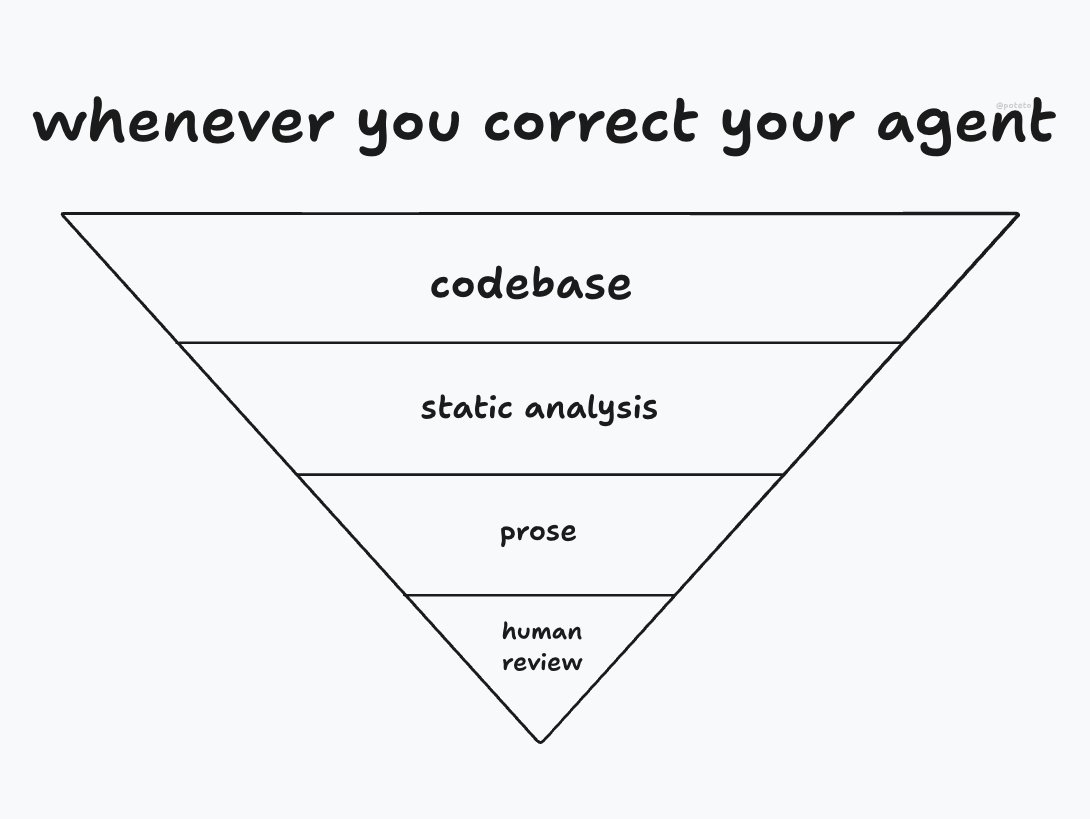
Diagram by @poteto.
The MUST lines sit third in that stack. They carry further backed by a lint rule, and human review catches what neither holds. Put most effort at the top, least at the bottom.
ADRs as strategic memory
In LLMs are tactical programmers I argued that strategic context lives in old pull requests, conversations, incidents, and the heads of the people who built the system. An agent cannot infer which awkward pattern is deliberate.
Architecture decision records are how that context gets next to the code. This repo has a stack of them from the agent-facing work: the single discovery module, section guides, the metered ask endpoint, serving modern and legacy MCP clients from one handler. Each is a decision an agent would otherwise rediscover badly.
Keep the ADR short: what was chosen, what was rejected, and what would force a revisit. That is enough for a tactical agent to stop redrawing the boundary.
The verification ladder
Failing cheaply ordered checks by how expensive it is to ignore them. docs/verification.md applies the same idea to an agent’s evidence.
Prefer the cheapest thing that answers:
- A unit test or type check.
- Format, lint,
astro check. - Start the app and probe it.
A probe: a running server, a headless browser or a screenshot settles only what the cheap evidence cannot. It needs a stated expectation. A probe with no prediction has nothing to settle.
Start the app when the developer asked, when the claim needs measurement the source cannot give, or when a prediction was wrong in a way the source cannot explain. Nothing to probe before an edit, and nothing after every edit.
An agent about to move elements or recolour them will sometimes start the app and screenshot first, before changing anything. A type check or lint would have answered. Stating the ladder outright tells it what to do cheaply first.
What is still yours
A budget, a lint rule, MUST lines, ADRs and a verification ladder do not replace judgment. They stop the agent from spending its context window on the wrong pages, and from spending your time on the wrong checks.
The interesting decisions are still the ones that never fitted in 5,000 characters: what to build, which trade-off to accept, whether the system is better than it was yesterday. The docs earn their keep when they make those decisions cheaper to reach.